On High Tech Blog

All ABout Online Activity

Another Tit-Bit...

Blogging is one of my hobbies, I write anything and everything here.

Homeowners — just what are you buying?

The idea is so simple. You pay a premium and the insurance company protects you. Yeh, right! When you go out shopping, you read the labels before you buy, don't you. Well, the same should be your habit when you're buying a homeowners insurance policy. Never just use a site like this to get online quotes and then buy a policy because it's low cost or affordable. You should read it before you buy.


So what are you looking for? Well, let's get technical. The insurance company protects you against "perils" except where there are "exclusions" telling you that there may be limitations on that cover. Often, those exclusions are the smaller print coming near the end of the policy when the insurer hopes you're attention is wandering. Check out exactly what is covered. If it's not clear, ask someone before you buy. The first part of the home insurance policy usually deals with "property protection". So that covers the structure of the place you call home together with everything permanently attached like the plumbing, the electrical wiring and all the other "stuff" (sorry another technical term including your air-conditioning, heating system, and so on). All the other buildings and structures on the land will be included so long as they're all used for domestic purposes. That covers the garage, shed, patio and fences/walls. Pay special attention to any "loss of use" provisions - that should cover your out-of-pocket expenses if you cannot live in your home while it's being repaired.


Then we get into the everyday personal property (usually called the "contents") owned by you and the family who live with you on a permanent basis. Depending on the wording, you may be covered for the cash value or replacement cost. But watch out. If you have anything unusual that's more expensive or difficult to replace, that's got to be specially endorsed on the policy. Some things may be excluded like a firearm, the car covered under your auto insurance policy, and so on. Other things may be included like the charges the local fire department may claim if it is called out, the cost of removing fallen trees or other debris after a storm, and so on. Everything else will have to be separately negotiated and added on to the policy as an endorsement.


Summary


The article advises that before you buy any homeowners insurance policy, you read through to see exactly what is included and what is excluded. If something is missing, you should negotiate a separate endorsement to get the cover you need.



Read More......

What to do when COBRA runs out?

We're into murky waters with questions about losing or switching employment. No-one wants to think about times of uncertainty, but if the economy continues its current problems, you have to plan round the jobs you have and can get. The Health Insurance Portability and Accountability Act of 1996 (HIPAA), which took effect in April, 2003, was designed to give you some protection for health insurance coverage when you are switching between jobs.


To get HIPAA coverage, your most recent cover must have been through a health plan. In total, you must have had at least eighteen months of continuous coverage. There must be no entitlement under Medicaid or Medicare and you must have used up all your entitlement under COBRA. If you give notice under HIPAA within 63 days of losing your health plan coverage, you have the right to buy cover. The health insurers cannot refuse you a health policy based on your medical history or pre-existing condition, nor can they change you a higher premium to deter you. In fact, many states have laws to limit what health insurers can charge in this situation. Thus, you have a right to get health insurance for you and your family and the premiums may be controlled. This is something you should investigate. Here health insurance online quotes may be of great use for you.


There are also privacy provisions to help keep your personal medical history confidential while making it available to the "right" people to give you health insurance and handle claims for treatment. HIPAA sets out national standards for handling health data to reduce the risks that your data is lost or stolen. There are also penalties if your data is sent to an unauthorized person. In theory, this is supposed to make doctors, healthcare providers and hospitals more accountable if something goes wrong. As a first step, you have the right to a copy of your health records. Most data processors make a handling charge for preparing the copy, but it is usually small. You also have the right to know who has seen your data and you can lay down limits on access. It's in your interests to take an active interest. You should maintain the accuracy of your records and ensure that only authorized individuals are allowed to access it in appropriate circumstances.


Read More......

What’s an HSA and how does it help?

The magic letters stand for a Health Savings Account and this represents a different way of solving the health plan problem. In effect, the HSA is self-insurance with tax advantages, allowing you to pay immediate medical bills, save for the future and provide protection for when you retire. You start off with a High Deductible Health Plan (HDHP). Because of the high deductible, the premiums are usually significantly less than for a more conventional policy. The idea is you pay the money saved into the HSA. Why should you do this? Well, the supposed advantages are that you control the account. You decide how the money is to be spent. If you have a standard plan, you're always waiting for the insurer to rule on whether to pay out on your claim. With an HSA, you no longer have to wait, you can authorize immediate payment. You also control how the money is invested. With a standard policy, you rely on the insurer to invest everyone's premiums to make them grow.


An HSA is not a product you buy. It's a savings account run by individuals (not couples). All you need to be able to open an account is cover from an HDHP meeting the current rules. The plan does not have to be in your name so long as you have cover, say, as a spouse. Note you can have other policies to pay some of your health costs for disability, long-term care and specific diseases. But you are ineligible if you have already signed up to Medicare or, as a member of the armed forces, you have Tricare. It's up to you to check what you are allowed to have. Your employer can set up a savings plan (although you cannot have both an HSA and a general HRA at the same time) or you can go to a bank, credit union, insurance company or one of the other bodies able to act as a trustee or custodian. A minimum deposit is usually required. You don't have to be employed to run an HSA although, if you don't file for Federal taxes, you cannot get the tax relief.


Put simply, this is a reasonable flexible and tax-efficient way of providing health insurance for yourself. But it has one key advantage. Although you cannot borrow against the money saved, you can make a one-time transfer from an IRA into an HSA, and the money from the account passes like a cash inheritance when you die. So unlike the usual health insurance premiums which are "lost", savings remain savings. The big question everyone who is eligible must ask is whether they want to self-insure. Obviously, if the savings are inadequate, the HDHP will potentially pay out. That policy is safety net but the coverage is limited. So you have to judge which works better for your family's circumstances. If you feel confident that there will always be enough available to pay for treatment during your life, this is tax free savings with you in control of the investment. But if you don't want to take the risk, a comprehensive health plan for the family may give you better peace of mind.


Read More......

Most economists in the Wall Street Journal's

Most economists in the Wall Street Journal's latest forecasting survey said
the U.S. doesn't need another round of stimulus now, despite expectations of
more severe job losses.

Just eight of 51 economists surveyed said more stimulus is necessary,
suggesting an average of about $600 billion in additional spending.

On average, the economists forecast an unemployment rate of at least 10%
through June 2010, with a decline to 9.5% by December next year.

"The mother of all jobless recoveries is coming down the pike," said Allen
Sinai of Decision Economics. But he doesn't favor more stimulus now, saying
"lags in monetary and fiscal policy actions" should be allowed to "work through
the system."

Like most respondents, Sinai said the bulk of the stimulus wouldn't be felt
until 2010. When asked how much the stimulus has helped the economy, 53% of
respondents said it has provided somewhat of a boost, but the larger effect is
still to come.

That sentiment echoes what the Obama administration has said about the
stimulus. While some top Democrats, such as Rep. Steny Hoyer of Maryland, have
said they are open to another round of stimulus, Rob Nabors, deputy director of
the Office of Management and Budget, said Wednesday that the administration
isn't discussing a new package.

Nicholas Perna of Perna Associates, one of the economists calling for more
stimulus, said more government aid is warranted. "The most obvious reason is
the need to offset the large fiscal drag just getting under way as state and
local governments raise taxes and cut spending as they attempt to balance their
budgets," he said.

Perna also noted that extended jobless benefits and medical-insurance
subsidies will be expiring in a few months.

Most economists appear content to take the wait-and-see approach, as on
average they are expecting the just-ended second quarter to be the last in
which gross domestic product contracts. They forecast growth rising more than
2% on a seasonally adjusted annualized basis in the first half of 2010.

Meanwhile, the median forecast sees the end of the recession next month.

Some economists had other reasons for opposing the stimulus. More than a
third of respondents said the government package will have only a small effect
on the economy, while 6% said the stimulus has hurt the economy.

"There's no easy solution," said Ram Bhagavatula of Combinatorics Capital,
who says the first stimulus will provide only a modest boost. "Every time the
government gives money to consumers, it goes right into the bank. The consumer
needs to rebuild savings, and that's a long, slow process."

Most economists were generally supportive of the Obama administration's plan
to overhaul financial regulations. Some 44% said the proposal was acceptable
given political realities, while 15% said it would make the financial system
safer. Still, 23% said the plan will stifle innovation and hurt growth, and 19%
said it is a feeble attempt at addressing vulnerabilities exposed during the
crisis.

On average, the economists said there is a 65% chance a regulatory overhaul
in some form would be signed into law by this time next year. That compares
with the 50% chance they placed on climate-change or health-care legislation
passing in the next 12 months.

"After being dragged into TARP, the administration will want to be seen as
extracting a return for taxpayer," Bhagavatula said, referring to the Troubled
Asset Relief Program, in which the government moved to recapitalize banks. The
White House is "fully incentivized," Bhagavatula added.

The program, started under the Bush administration, has fueled populist anger
over government bailouts.

The administration's performance continues to divide economists. President
Barack Obama and Treasury Secretary Timothy Geithner both got median grades of
70 out of 100 for their handling of the financial crisis. That is better,
however, than the failing median grades of 50 and 60 for former President
George W. Bush and ex-Treasury chief Henry Paulson, respectively.

By contrast, Federal Reserve Chairman Ben Bernanke remains at the head of the
class with a median grade of 85; 93% of respondents said he should be
reappointed by Obama in 2010.
Read More......

Accelerated productivity rates

Accelerated productivity rates, and not irrational
expectations, were the main force behind the rapid appreciation in housing
prices in the U.S.

That's the argument of a paper published Thursday by the Federal Reserve Bank
of New York, by economist James Kahn. The research tilts against the commonly
held view that the sharp run up in home prices seen into 2007 was a bubble that
never should have happened.

"Changing economic fundamentals - specifically, swings in labor productivity,
or output per hour of work - played a significant role in the movements of
housing prices," he wrote. "These productivity swings helped determine the
price of housing through their effects on income growth and long-term income
expectations - factors that directly influence what consumers are ready to pay
for housing and what mortgage providers are willing to lend."

Kahn argues that rising productivity rates boosted incomes, growth and
expectations of future activity, but also helped create "a sense of optimism"
that caused people to be willing to pay more for housing. It also influenced
what sort of financing banks were willing to offer homeowners.

When productivity rates began to slow in 2007, a lot of the optimism rightly
wilted, and thus, housing prices began their descent.

Much of what Kahn argues stands against the prevailing assessment of what's
happened to housing markets over recent years. Most economists believe, in a
view shared by most Fed officials, that housing prices were indeed a bubble:

Home buyers had unreasonable expectations of how much their homes would
appreciate, and a sea change in the way Wall Street created and financed
mortgages created a game of musical chairs that allowed prices to rise for a
number of years.

But as soon as trouble brewed - it started in mortgages for subprime
borrowers - the game was over. House prices in many parts of the economy
crashed, foreclosures shot higher, chaos and pain reverberated through the
financial system, and the economy fell into its deepest recession since the
Great Depression.

With an end to the recession coming into view, it's still an open question
whether the housing market has stabilized, both in terms of prices and selling
activity. Some say yes, but without much conviction.

Kahn doesn't disagree that other factors had an impact on housing. But he
argues his model shows a pretty strong correlation between productivity rates
and housing prices over the last 45 years.

"The current housing crisis stemmed in large measure from a change in
economic fundamentals and was only exacerbated by credit market conditions,"
Kahn wrote. Moreover, what some believe were declines in credit standards may
in fact be justifiable given what was known then about the economy.
Read More......

Accelerated productivity rates

Accelerated productivity rates, and not irrational
expectations, were the main force behind the rapid appreciation in housing
prices in the U.S.

That's the argument of a paper published Thursday by the Federal Reserve Bank
of New York, by economist James Kahn. The research tilts against the commonly
held view that the sharp run up in home prices seen into 2007 was a bubble that
never should have happened.

"Changing economic fundamentals - specifically, swings in labor productivity,
or output per hour of work - played a significant role in the movements of
housing prices," he wrote. "These productivity swings helped determine the
price of housing through their effects on income growth and long-term income
expectations - factors that directly influence what consumers are ready to pay
for housing and what mortgage providers are willing to lend."

Kahn argues that rising productivity rates boosted incomes, growth and
expectations of future activity, but also helped create "a sense of optimism"
that caused people to be willing to pay more for housing. It also influenced
what sort of financing banks were willing to offer homeowners.

When productivity rates began to slow in 2007, a lot of the optimism rightly
wilted, and thus, housing prices began their descent.

Much of what Kahn argues stands against the prevailing assessment of what's
happened to housing markets over recent years. Most economists believe, in a
view shared by most Fed officials, that housing prices were indeed a bubble:

Home buyers had unreasonable expectations of how much their homes would
appreciate, and a sea change in the way Wall Street created and financed
mortgages created a game of musical chairs that allowed prices to rise for a
number of years.

But as soon as trouble brewed - it started in mortgages for subprime
borrowers - the game was over. House prices in many parts of the economy
crashed, foreclosures shot higher, chaos and pain reverberated through the
financial system, and the economy fell into its deepest recession since the
Great Depression.

With an end to the recession coming into view, it's still an open question
whether the housing market has stabilized, both in terms of prices and selling
activity. Some say yes, but without much conviction.

Kahn doesn't disagree that other factors had an impact on housing. But he
argues his model shows a pretty strong correlation between productivity rates
and housing prices over the last 45 years.

"The current housing crisis stemmed in large measure from a change in
economic fundamentals and was only exacerbated by credit market conditions,"
Kahn wrote. Moreover, what some believe were declines in credit standards may
in fact be justifiable given what was known then about the economy.
Read More......

The Bank of England

The Bank of England said Thursday that it is reducing the
size of its U.K. government bond purchases to GBP4.5 billion next week, from
GBP6.5 billion per week recently, to ensure it can afford to keep buying
private-sector securities under its quantitative-easing policy.

The BOE will conduct a GBP2.25 billion reverse auction of eligible gilts
maturing in the 2022 to 2030 range Monday, with another GBP2.25 billion
operation covering 2015 to 2019 maturities scheduled for Wednesday.


It also said it will exclude the 4.75% 2020 gilt from its buyback auctions
"until further notice," citing the fact that it now owns 70% of the free float,
or the total amount of that gilt in issue, excluding government holdings.

Earlier Thursday, the BOE's Monetary Policy Committee surprised investors
when it decided not to increase the GBP125 billion of public and private
securities that it is buying with freshly created central bank money - a policy
known as quantitative easing.

"In order to ensure that purchases of private-sector assets can continue to
be financed through the creation of central bank reserves over the next month,
the bank is reducing the size of the individual gilt purchase auctions," the
BOE said in a statement.

As a result, gilt purchase operations are expected to continue until July 29,
one week before the MPC's next meeting, it said.

"The bank will continue to keep the identity of gilts eligible for purchases
under the APF [Asset Purchase Facility] under review, in light of the
proportion of the 'free float' that it holds and their relative richness to the
curve," it added.
Read More......

The world's richest and its largest developing

The world's richest and its largest developing
economies made a little progress in bridging the gaps that divide them
Thursday, agreeing on the ultimate goal for climate change negotiations, and a
relaunch of stop-start trade talks that have dragged on for eight years.

But new gaps are opening up, not least a brewing disagreement over the role
that the U.S. dollar and other currencies should play in the international
monetary system. That may prove just as thorny and insoluble as trade and
climate change have been over the past decade.

Meeting close to this mountainous Italian city surrounded by green hills,
leaders from the Group of Eight rich economies and the Group of Five large
developing economies agreed that the global climate shouldn't be allowed to
warm by more than 2 degrees Celsius from pre-industrial temperatures.

And they tasked their trade ministers with reinvigorating the Doha round of
trade talks at a meeting that will precede their next rendezvous, when they
join other leaders of the G20 in Pittsburgh in September.

But those were the easier steps to take. They did not agree on specific
targets for cutting their own carbon emissions in the near-term, nor did they
explain what concessions would be made to seal a deal on Doha by 2010.

And lurking in the wings is an issue that may prove just as difficult to deal
with. Speaking to the leaders, Chinese State Councilor Dai Bingguo said that
the international currency system must become more diversified.

Dai told the leaders that "there's a need to improve the international
monetary system, enhance the reserve currency and regulating regime, maintain a
relative stability of the exchange rates of the main international reserve
currencies and promote a more diversified and reasonable international currency
system."

The Chinese government has made similar statements before, but not directly
to G8 leaders, including U.S. President Barack Obama. The issue of how nations
should store their wealth and conduct trade is now on the agenda, and can't be
ignored for long.

Developing economies, notably China, keep most of their reserves in U.S.
dollar securities, largely Treasury bonds. But they have no influence over the
policies that affect the value of those reserves. Much of their international
trade - even among themselves - is also conducted in dollars.

U.K. Prime Minister Gordon Brown said there had been no "real" discussion
about the U.S. dollar's role.

"There was not a serious discussion about this and it was not on the agenda
for discussion", Brown said.

However, he conceded that discussing the dollar's role is "something the
world has got to do."

"But the suggestion that there's something that's going to happen in the next
few weeks and months is just not realistic and therefore I don't think we can
give people the impression that there's some big change about to happen," he
said.

The White House said Thursday that it doesn't see any threat to the U.S.
dollar's status as a reserve currency, downplaying recent calls for a more
diverse set of global reserves.

"I think that despite whatever talk you might hear, I don't see that there's
any movement away from the notion of the dollar being that currency," White
House spokesman Robert Gibbs said Thursday.

Given the history of climate change and trade talks, Brown is right to doubt
that any big changes are likely to happen soon.

U.S. President Barack Obama said there's a long way to go before a deal on
climate change can be struck at a summit to be held in Copenhagen in December.

"We've made a good start but I'm the first one to acknowledge that progress
on this issue will not be easy," Obama said. "It is no small task for 17
leaders to bridge their differences on an issue like climate change."

Developing countries are unwilling to set targets to cut their emissions
until they see developed countries taking a lead. The G8 leaders Wednesday
pledged to cut their emissions by 80% by 2050, but that's a long way off, and
well beyond the political lifetimes of the G8 leaders.

Read More......

The dollar this week has extended

The dollar this week has extended this year's downtrend
against the yen, and charts suggest that traders have to give the dollar more
room on the downside.

The dollar Wednesday fell to Y91.79, which is the current low for the
downtrend from the April high of Y101.49. It's technically weak in Thursday
trading below Y93.04, but the practical difficulty for traders is the fact that
the dollar now is also crowding a potential interim bottom at Y92.46.

Finally, if trades are stopped above Y93.04 then the dollar would be on the
up to Y95-area targets.


More alluring for the dollar bears perhaps is the possibility that decisive
trading below Y92.46 might point the dollar down to Y87.31.

The point is that a long-term downtrend is effective now. See chart at this
Web address:

http://www.dowjoneswebservices.com/chart/view/2402

The dollar's immediate technical context is the downtrend from the 1998 high
of Y147.71. The downtrend low, recorded late last year is Y87.09. It's
remarkable that the dollar finished 2008 trading at Y90.75 and that 2009
trading began at Y90.74, so traders can anticipate an important long-term
interim bottom if and when Y90.75 is tested.

Euro Pushes The Yen Back


The euro, near Y130, is technically strong on the daily chart above Y125.66
and it's going for Y132-area resistance. But a convincing move below Y125.66
would be the signal for a dip to Y123.35. In that case extended lower trading
would be targeting Y115.06.


Read More......

US JOBLESS CLAIMS SLIDE, BUT MAY PROVE TEMPORARY

US JOBLESS CLAIMS SLIDE, BUT MAY PROVE TEMPORARY


New U.S. claims for state unemployment benefits unexpectedly plunge by 52,000
last week to their lowest level. And the Commerce Department reports that U.S.
wholesalers cut inventories again in May, by 0.8%.

REPEAT BORROWERS DRIVE DEMAND FOR PAYDAY LOANS


Repeat borrowers account for the bulk of payday loan volume, a new study
concludes, giving fresh fodder to critics who charge the industry traps people
in a cycle of debt.

FREDDIE SAYS 30-YEAR MORTGAGE STILL ABOVE 5%


Mortgage rates are down again, with the 15-year fixed rate dipping to 4.69%
from 4.77% last week, according to Freddie Mac, but the average rate on 30-year
fixed-rate mortgages remained above 5%.

IMF SAYS NEW WORRIES MOUNT AS CRISIS EASES


Avoiding the worst of the global economic crisis has created new problems
that world leaders need to address swiftly, International Monetary Fund
Managing Director Dominique Strauss-Kahn says.

US STOCKS STICK TO NARROW RANGE


U.S. stocks make only small moves as investors welcome upbeat earnings news.
Consumer stocks lag the broader market, while raw-materials names post the
strongest gains.

LAWMAKERS SOUND ALARM ON COMMERCIAL REAL ESTATE


U.S. lawmakers ring alarm bells about the troubled commercial real estate
industry, which has been walloped by the credit crunch and an implosion of
property values.

BOE CUTS NEXT WEEK'S GILT BUYING


The Bank of England says it is reducing the size of its U.K. government bond,
or gilt, purchases to £4.5 billion next week from £6.5 billion this
week, to ensure it is able to keep buying private-sector securities with
freshly created central bank money.

MOODY'S CUTS RATINGS ON $925M JUMBO RMBS


Moody's Investors Service cut its ratings on $925 million of jumbo
mortgage-backed securities issued by Thornburg Mortgage from 2002 to 2004,
adding to the total of $7.4 billion in jumbo deals earlier this week.

SEC TO ISSUE GUIDANCE ON CALIFORNIA IOUS


The Securities and Exchange Commission will issue "guidance" on the IOUs, or
registered warrants, that California started issuing last week to conserve
about $3 billion in cash, says a person familiar with the matter.

NEW MEXICO BANK MUST BOOST FINANCIAL HEALTH


First State Bancorporation of Albuquerque, N.M., must take certain steps to
improve its assets and manage credit risk under an agreement it entered into
with the Federal Reserve.


Read More......

GM Could Exit Bankruptcy Worth More Than $63B - Judge

The reorganized General Motors Corp. (GMGMQ), which could exit bankruptcy
protection as early as Thursday, will have an enterprise value between $63.1
billion and $73.1 billion, according to the bankruptcy judge overseeing the
auto maker's Chapter 11 case.

Judge Robert Gerber of the U.S. Bankruptcy Court in Manhattan pegged the
"new" GM's value in a Wednesday order rejecting appeals attempting to block the
sale of the Detroit auto maker's assets to a government-controlled entity.

That new entity, to be called General Motors Co., could exit from Chapter 11
protection any time after 12:00 p.m. EDT, when a window to consider protests to
the sale approved Sunday closes. But the company isn't expected to make an
announcement about its exit from bankruptcy until Friday.

The "new" GM will assume $48.4 billion in obligations from the old company,
Gerber noted in his order.

The judge also said that the new automaker will provide the old company's
unsecured creditors equity and warrants worth between $7.4 billion and $9.8
billion - more than creditors would likely have received if GM liquidated.

Gerber gave the financial sketch of the reorganized GM in explaining why the
transaction he approved Sunday was the best possible outcome for creditors,
including asbestos and personal injury claimants who protested the deal.

The claimants can take their complaints to the U.S. District Court, but
Gerber said he would not allow the appeals to prevent the sale from closing
this week.

GM is now poised to complete a transaction that would split off its good
assets to a new company owned largely by the U.S. government while leaving the
rest to be wound down in bankruptcy.

The U.S. will own 60.8% of the new company. The United Auto Workers health
care fund will get a 17.5% stake, with 11.7% going to Canada. The GM left in
bankruptcy will get a 10% stake plus warrants to acquire more to pay off
unsecured creditors.

Under GM's sale, asbestos claimants and accident victims would be blocked
from going after the new, restructured GM for compensation, although those in
accidents that occur after the sale closes can sue the new GM. Opponents say
the restriction violates bankruptcy law.

But in his opinion rejecting the appeals, Gerber said the transaction was not
only in the best interest of GM creditors, but for the society as a whole.

"If GM were to have to liquidate, the injury to the public would be
staggering," Gerber said.

He referenced the potential losses of jobs and healthcare coverage for GM's
225,000 employees worldwide and 500,000 retirees, the staggering impact that
would have on local tax bases, and the fallout throughout the auto industry. If
GM were allowed to fail, Gerber said the number of supplier bankruptcies would
"multiply exponentially."

"Under these circumstances, I find it hardly surprising that the U.S.,
Canadian, and Ontario governments would not stand idly by and allow those
consequences to happen," Gerber said in court papers.


Read More......

Stock Strategist: The Looming Threat of Municipal Bond Defaults

Morningstar Logo
Membership Portfolio Stocks Options Funds ETFs Markets Tools Personal Finance Discuss
Stock Strategist
The Looming Threat of Municipal Bond Defaults
Can insurers take another hit?
tab_bar
by Jim Ryan | 7/6/2009 6:00:00 AM
 

The arsenal of stimulus programs seemingly has stemmed the tide of capital market disasters and some think "green shoots" are taking root. But a new problem, perhaps even more daunting, is popping up: Municipalities across the U.S. have deep budgetary problems and the chance of default on their bonds grows every day. Recent estimates put the State of California budget deficit in excess of $24 billion, about a quarter of the size of the total budget, a shortfall that must be addressed in the next 30 days. What's more, while California has become the poster child for the problem, many other state and local governments are in the same fix. Some estimates put the total shortfall for all state budgets at almost $170 billion.

To be fair, some municipal bond holders are somewhat better protected than others. As pointed out in an article by Charles Schwab & Company, state general obligation bondholders in California are second in line for payment after mandatory education benefits are paid. Furthermore, because the bonds are backed by the full faith and credit of the state, alternatives such as raising state taxes to pay bond creditors is still possible and allowable under the California state constitution. However, payments from the state to local municipalities could be cut, endangering the ability of those bond issuers to meet their payments. Not all municipal bonds are state-backed general obligation bonds, and the spill-over effects from defaults at the state level to local government, especially those backed by only specific revenue districts, can be equally dramatic. Even if default never occurs, the credit rating of the bond could be cut, reducing the value of the bond in the near term.

To read more, click here.

Sponsored Links
       
    Buy a Link Now
       
 
NEW - ETF Center and ETF Screener
Peruse our new ETF center, ETF screener, and step-by-step tips for using ETFs in our new ETF Solutions Center.
National Bestseller! The Five Rules for Successful Stock Investing
Learn how to separate the great companies from the justifiably undervalued ones. Only $10.95 (plus shipping and handling). Click here.
Search
Most Recent Articles
FTSE's Resource Stocks Back Under Pressure
Indian Indices Reeling after Budget
Seven High-Conviction Stocks from the Ultimate Stock-Pickers
Latest Analyst Reports
Piedmont Natural Gas Company
VIVO Holding Company
Atmos Energy Corporation
People's United Financial, Inc.
LeMaitre Vascular, Inc.
ABOUT OUR E-MAIL
TO UNSUBSCRIBE this e-mail address to the Stock Strategist newsletter, please click "reply" and then click "send." This will unsubscribe only this e-mail address to this specific newsletter.
All subscription changes will take effect within one business day. Replies are not read by individuals, so please do not use this for queries about Morningstar.com. If you have questions about Morningstar.com or your membership, send a note to joe@morningstar.com.
ABOUT OUR PRIVACY POLICY
Please click here to learn about Morningstar's privacy policy.
(c) Copyright 2009.
Morningstar, Inc.
22 West Washington
Chicago, Illinois, 60602
All rights reserved.
Read More......

Is Owens-Illinois, Inc. a Good Investment?

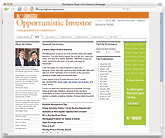
Morningstar Opportunistic Investor
    Morningstar  
 
Morningstar Opportunistic Investor
Opportunistic Investor
In each monthly issue of Morningstar Opportunistic Investor, you'll get:
 Frequent, flowing commentary, including articles, analyst notes, and new ideas
 Our philosophy on how we evaluate a company (the good, the bad, and the ugly), plus continual, multifaceted insight
 Viable ideas for right now, plus research in progress and ideas just beginning to take shape
 Updates to our six-figure, real-money Mosaic Portfolio, actively adjusted to profit from new opportunities--this is where we put our ideas to work, so you can invest right along with us
 Research, analysis, market, and company news--plus our opinions and where we stand on the issues
 E-mail updates and transaction alerts
 Detailed financial models outlining how we reach our conclusions and the variable inputs we use
Learn More
 

Case Study: Why we passed on Owens-Illinois, Inc. OI.

Look over our shoulders at our research and analysis process to see if it's right for you. Start a 30-day trial now.

At Morningstar Opportunistic Investor, we pursue a lot of ideas. We'll consider just about anything: no-moat stocks, deep cyclicals, arbitrage opportunities, spin-offs, bankruptcy reorganizations, and so on.

Of course, that means our rejection rate is very high--often including stocks that might look good at first glance. Fortunately, we can learn just as much from a reject as a pick, so here's an inside look at one of the stocks that wound up in our "pass" pile, as published in a past article of Opportunistic Investor.

The surface looks great.
Recently, we dug deep into O-I (formerly Owens-Illinois Glass Company) the world's largest maker of glass bottles. A long list of merits made it appear interesting:

  • O-I's end sectors looked recession resilient--beer and soda bottles, baby food jars, and wine and spirit bottles comprise the vast majority of the glass bottle market.
  • O-I is the largest of the three key players in the United States' tightly consolidated market. Their two competitors seem to be struggling.
  • Over the last few years, O-I has raised prices, emphasizing margins over volumes. This has borne fruit--operating margins increased from 3% in 2005 to 14% in 2008.
  • O-I has been cutting costs and rationalizing capacity aggressively in the U.S. and is starting to do the same in Europe.
  • The company has pushed into many overseas developing markets, offering faster growth and superior margins than its U.S. operations. In parts of Eastern Europe and many Latin American countries, it's the only player in the country. Given the cheapness, bulk, and fragility of glass bottles, most are consumed within a few hundred miles of the plant.
  • A big asset sale a few years ago allowed the company to clean its balance sheet materially and focus on its core business of glass bottles, although it still carries quite a bit of debt.
  • Free cash flow generation has been strong for a few years, allowing the company to steadily retire debt. At $10, the stock was trading for about 5 times 2008 free cash flows.
  • The company had been clobbered by asbestos litigation, which should gradually wind down, freeing up cash and bolstering margins.

There. We've painted a pretty picture. So why did we take a pass?

 
Only Morningstar Opportunistic Investor digs deeper. Click here to start a 30 day trial.

The deeper story.
Upon further analysis, the Morningstar Opportunistic Investor--backed by our field of 100+ equity analysts--felt that many of these positive dynamics were unraveling. The risks are much greater than at first blush.

A glass bottle plant is a relatively rigid operation. The furnaces that melt silica into molten glass consume a massive amount of energy, and they are difficult to shut down and restart. There are a lot of fixed costs, and it's difficult to vary production levels without damaging margins. O-I has been rationalizing capacity by shutting down production lines and factories, which is very costly, instead of making its factories more flexible (which might not even be possible). What's more, the U.S. and European segments are heavily unionized, adding to inflexibility. For cash flows to hold up, especially in the short run, neither volume nor price can drop. And with a heavy load of debt the short run can be incredibly important.

For the last few years, O-I lost some volume due to price increases. The increased margins far outweighed lost sales, especially as the company shut down high-cost operations. But things fell apart at the end of 2008. Volumes fell more than 10% in North America, and probably in Europe and Asia. Operating profits fell by half. Management blamed inventory destocking and consumers switching from imported bottled beer to domestic canned beer, implying that these are short-term problems. This was partially true, but it was not the whole story.

Data from the U.S. Census Bureau showed that glass bottle volumes were weak across the industry, but O-I suffered more than average. It was losing market share.

So we dug deeper. By trawling through past conference calls and talking with the company, we identified an interesting trend. Even though the U.S. industry was consolidated, it did not compete rationally. O-I's competitors were taking advantage of O-I's price hikes to raise their own prices--just not as high as O-I. They were stealing volumes but keeping all the profits, and it seems to have accelerated as the economy turned south.

This situation is clearly unstable. O-I can't afford to cede share to its competitors. Based on conference calls and our own conversation, management is clearly unhappy. We think management is going to respond by using price as a weapon to regain share. This would almost certainly spark a price war, destroying margins. Yet O-I may have no choice. If it doesn't fight for share, it could be eaten alive by fixed costs, inflexible labor, and interest payments.

There are other issues--the troubled European bottled water industry (think Pellegrino); weakening foreign currencies; exposure to increasingly unstable Eastern Europe; weakening demand for craft beers, wines, and spirits; legacy asbestos litigation costs; and competition with aluminum cans--just to name a few. Most of these are short-term or fixable. But the scariest is a potential price war, coupled with heavy debt.

This is what made us decide not to go further with O-I. It may still be viable. If margins hold up and volumes recover, the stock is probably worth close to $40. But it's too hard to call. Right now, we think O-I is a high-risk, high-reward proposition, which doesn't make it a good fit for the portfolio at this time.

 
Sign up for 12 months of unrivaled analysis and insight. Click here.

So, what can we learn?
First, at Morningstar Opportunistic Investor, we always seek out disconfirming evidence. It would have been easy to overlook O-I's shortcomings and assume a huge potential upside--if current dynamics don't completely break down. Behavioral psychologists call this confirmation bias--seeking evidence that confirms your preconceptions.

Next, be aware of operating and financial leverage. O-I had operated admirably for the past several years, and its financial leverage looks fairly modest given recent profitability (it has about $3 billion of net debt and generated about $1.5 billion of EBITDA in 2008). However, given their high fixed costs, a price war would cause profitability to implode.

Third, we steer clear of accelerating competition and price erosion--especially if prices had been stable. It's rare for a company to be able to cut costs in line with significant price erosion. So when it happens, especially unexpectedly, margins are likely to weaken. In some industries, prices go down constantly and firms anticipate deflation. But generally, increasing price competition disrupts long-established industry dynamics.

Where can you find out more?
This case study illustrates key tenets in the Morningstar Opportunistic Investor strategy--because we look for companies with identifiable catalysts to unlock value, and we seek out potential rewards many times greater than the risk we take, we need to search for the variables that aren't in plain view.

If that sounds like the sort of absorbing analysis that interests you, we encourage you to sign up for Morningstar Opportunistic Investor. Your subscription will bring you more in-depth analysis like we've demonstrated for O-I, as well as updates on our six-figure Mosaic Portfolio and more. Click here for more details and to sign up now.

Regards,

Mike Tian and Justin Perucki
Editors, Morningstar Opportunistic Investor

 
Join Morningstar Opportunistic Investor in finding growth in nontraditional places. Click here to sign up.
Best Regards,
Mike TianJustin Perucki
Mike Tian and Justin Perucki
Editors, Morningstar Opportunistic Investor

The Morningstar Guarantee
If you are unhappy with Opportunistic Investor for any reason, cancel within 30 days of your trial start date by calling toll-free 1-866-910-1145, and your credit card will not be charged. After that, you may cancel at any time, and we will refund the remaining months left on your subscription. Your satisfaction is our priority.


About Our E-mail
This message was sent by an automatic mail-sending program. If you are a Morningstar.com member, and you want to unsubscribe from future marketing e-mails, please click here. You may be asked to log in first. You can also opt out of future marketing e-mails by calling 1-312-424-4288. All subscription changes will take effect within five business days. If you have questions about Morningstar.com or your membership, send a note to joe@morningstar.com. Please click here to learn about Morningstar's privacy policy.

© Copyright 2009. All rights reserved. Morningstar, Inc. | 22 West Washington Street | Chicago, Illinois 60602


Read More......

Personal Finance Daily: Bank fees go to bottom line, out of your hide

MarketWatch
Personal Finance Daily
JULY 06, 2009

Monday's Personal Finance stories

By MarketWatch


Don't miss these top stories:

It was nice of the federal government to bail out the banks and shore up our ailing financial system. And the banks have returned the favor by pumping all those freshly printed dollars back into consumer hands and shoring up family balance sheets. Not.

In fact, banks and credit-card companies have not only taken our money through the Treasury, they keep taking it directly from our wallets with an increasing number of fees and charges that grow more expensive by the day. With profits hard to come by, financial institutions have become addicted to that fee income and they have moved to lock in as much of it as they can before tougher federal regulations go into effect.

That's not all bad, since big fees can give consumers an incentive to pay more attention to their finances and to find better ways to save. The problem is that a lot of the charges are not readily apparent -- getting dinged for making a phone inquiry of your bank, for instance -- and can trip you up even when you're trying to be careful.

You'll need to be extra vigilant about your own bottom line to avoid contributing inordinately to your bank's.

-- Steve Kerch, assistant managing editor/personal finance

CONSUMER WATCH

Ten sneaky bank fees that sting unsuspecting consumers

Banking and credit-card consumers need to keep their guard up as financial institutions increasingly impose new fees and charges to balance their books in the wake of the continued economic downturn.
See Consumer Watch.


Michael Jackson memorabilia buyers are lost in Neverland

Michael Jackson had barely been pronounced dead last week when the memorabilia market heated up. Copies of his best-selling album, "Thriller" -- worth $10 by most expert accounts on the morning of June 25 -- were fetching five to 15 times that much by nightfall.
See Chuck Jaffe.


INVESTING

Target-date funds were roundly criticized after crash -- how are they doing now?

Given the dramatic, wealth-killing market crash of 2008, it's not surprising that target-date funds faced a lot of criticism in recent months. Some of these so-called set-it-and-forget-it retirement vehicles lost investors as much as 40% of their savings last year.
See Andrea Coombes' Way's & Means.


Investors jump into high-yield -- but perhaps too late

High-yield bond funds are enjoying a bumper year, with returns above 20%. But while investors are pouring billions in of dollars, it's likely they've missed the best returns.
See Fund Watch.


Exchange-traded fund geared to hedge higher fuel prices

Families who pack up the car this Fourth of July weekend will spend much less on gas than last year -- prices are down by more than a third from last summer. But when it comes to fueling your investment portfolio, a specialized exchange-traded fund may hedge against unwelcome oil-price spikes.
See ETF Investing.


T. Rowe Price fund is one to watch -- but not necessarily buy

Mutual-fund firms come up with new ideas all the time. But every now and again, a firm comes out with an old idea, creating a product that overlaps its current line-up. The new fund always sounds promising, but investors should wonder if the new issue is as good an idea for customers as it is for the managers.
See Chuck Jaffe.


Bright investment outlook for 'cleantech' stocks is becoming cloudier

The greening of America is sprouting a few weeds. Following President Barack Obama's election and Democratic congressional victories in November, many investors expected strong political action to combat climate change and turned bullish on the green-energy sector. But such optimism has since softened as political realities and the impact of the frozen credit markets hit the sector, also known as cleantech.
See Weekend Investor.


Getting into income funds now could be attractive

The financial crisis seemed to take a bad situation and make it worse for investors owning mutual funds focused on paying out income from stocks or bonds. The good news, however, is these same trends have created opportunities for investors looking to put fresh money to work.
See full story.


Wendy's/Arby's get cooking with new management team

Shares of Wendy's/Arby's Group have slid more than 30%, to around $4, since April, amid worries about declining sales at Arby's and management's reluctance to reveal how it will use the proceeds from the company's recent $565 million bond offering. But the prospects for greater operating efficiencies and rapid growth in the restaurant chain's cash flow suggest the shares could be worth at least $6 apiece -- and maybe as much as $9 in the next few years.
See full story.


Ten pricey S&P stocks

After the big rally, it's time to pare overpriced stocks. Barron's screened the S&P 500 and came up with a list of richly valued companies, reports Dimitra DeFotis.
 Watch Video Report.


HEALTH CARE

More surprises as health-reform efforts accelerate

There were three major developments this week on the health-reform front, and more action promises to begin next week when Congress reconvenes after the July 4th holiday. The proposed overhaul got more personal as President Obama hugged a tearful cancer patient who described her struggles to find employment and health insurance as part of a town hall meeting at the White House. In a surprise move, the nation's largest employer backed a controversial element that would require employers to extend coverage or pay a penalty, and the Senate's health committee released a new version of its reform bill that brought the estimated cost down substantially, potentially making it more politically palatable.
See Health Matters Blog.


AUTOMOBILES

2009 GMC Sierra Hybrid: A few jolts, but a lot of volts in this truck

Out in the rolling hills of the Potomac Valley, pickup trucks may outnumber the dogs. It's a great place to test the latest truck from GMC.
See Auto Review.


Isaac buys a car -- and a whole lot more

Well, it's official: There are now two Saabs sitting in front of the Yoder house.
See Yoder & Son.


REAL ESTATE

Madoff penthouse seized by feds

U.S. marshals seized Bernard Madoff's luxury penthouse apartment, including jewelry, art and clothing.
 Watch Video Report.


Get the latest news on our mobile site: http://www.marketwatch.com/m


MarketWatch has sent you this newsletter because you signed up to receive it.
To ensure you receive this newsletter in the future, please add marketwatchmail.com to your list of approved senders.
Sent to: andi.fx8888.online@blogger.com

Unsubscribe | Subscribe

Copyright 2009 MarketWatch, Inc. All rights reserved.
MarketWatch, the MarketWatch logo, and BigCharts are registered trademarks of MarketWatch, Inc.
By using this site, you agree to the Terms of Service and Privacy Policy (updated 6/26/07).

MarketWatch - Attn: Customer Service, 201 California St., San Francisco, CA 94111

Read More......