 |  | | In each monthly issue of Morningstar Opportunistic Investor, you'll get: | |  | Frequent, flowing commentary, including articles, analyst notes, and new ideas | | | Our philosophy on how we evaluate a company (the good, the bad, and the ugly), plus continual, multifaceted insight | | | Viable ideas for right now, plus research in progress and ideas just beginning to take shape | | | Updates to our six-figure, real-money Mosaic Portfolio, actively adjusted to profit from new opportunities--this is where we put our ideas to work, so you can invest right along with us | | | Research, analysis, market, and company news--plus our opinions and where we stand on the issues | | | E-mail updates and transaction alerts | | | Detailed financial models outlining how we reach our conclusions and the variable inputs we use | |  | | | | | Case Study: Why we passed on Owens-Illinois, Inc. OI.
| | | Look over our shoulders at our research and analysis process to see if it's right for you. Start a 30-day trial now. | | | At Morningstar Opportunistic Investor, we pursue a lot of ideas. We'll consider just about anything: no-moat stocks, deep cyclicals, arbitrage opportunities, spin-offs, bankruptcy reorganizations, and so on. Of course, that means our rejection rate is very high--often including stocks that might look good at first glance. Fortunately, we can learn just as much from a reject as a pick, so here's an inside look at one of the stocks that wound up in our "pass" pile, as published in a past article of Opportunistic Investor. The surface looks great.
Recently, we dug deep into O-I (formerly Owens-Illinois Glass Company) the world's largest maker of glass bottles. A long list of merits made it appear interesting: - O-I's end sectors looked recession resilient--beer and soda bottles, baby food jars, and wine and spirit bottles comprise the vast majority of the glass bottle market.
- O-I is the largest of the three key players in the United States' tightly consolidated market. Their two competitors seem to be struggling.
- Over the last few years, O-I has raised prices, emphasizing margins over volumes. This has borne fruit--operating margins increased from 3% in 2005 to 14% in 2008.
- O-I has been cutting costs and rationalizing capacity aggressively in the U.S. and is starting to do the same in Europe.
- The company has pushed into many overseas developing markets, offering faster growth and superior margins than its U.S. operations. In parts of Eastern Europe and many Latin American countries, it's the only player in the country. Given the cheapness, bulk, and fragility of glass bottles, most are consumed within a few hundred miles of the plant.
- A big asset sale a few years ago allowed the company to clean its balance sheet materially and focus on its core business of glass bottles, although it still carries quite a bit of debt.
- Free cash flow generation has been strong for a few years, allowing the company to steadily retire debt. At $10, the stock was trading for about 5 times 2008 free cash flows.
- The company had been clobbered by asbestos litigation, which should gradually wind down, freeing up cash and bolstering margins.
There. We've painted a pretty picture. So why did we take a pass? | | | | | | Only Morningstar Opportunistic Investor digs deeper. Click here to start a 30 day trial. |  | The deeper story.
Upon further analysis, the Morningstar Opportunistic Investor--backed by our field of 100+ equity analysts--felt that many of these positive dynamics were unraveling. The risks are much greater than at first blush. A glass bottle plant is a relatively rigid operation. The furnaces that melt silica into molten glass consume a massive amount of energy, and they are difficult to shut down and restart. There are a lot of fixed costs, and it's difficult to vary production levels without damaging margins. O-I has been rationalizing capacity by shutting down production lines and factories, which is very costly, instead of making its factories more flexible (which might not even be possible). What's more, the U.S. and European segments are heavily unionized, adding to inflexibility. For cash flows to hold up, especially in the short run, neither volume nor price can drop. And with a heavy load of debt the short run can be incredibly important. For the last few years, O-I lost some volume due to price increases. The increased margins far outweighed lost sales, especially as the company shut down high-cost operations. But things fell apart at the end of 2008. Volumes fell more than 10% in North America, and probably in Europe and Asia. Operating profits fell by half. Management blamed inventory destocking and consumers switching from imported bottled beer to domestic canned beer, implying that these are short-term problems. This was partially true, but it was not the whole story. Data from the U.S. Census Bureau showed that glass bottle volumes were weak across the industry, but O-I suffered more than average. It was losing market share. So we dug deeper. By trawling through past conference calls and talking with the company, we identified an interesting trend. Even though the U.S. industry was consolidated, it did not compete rationally. O-I's competitors were taking advantage of O-I's price hikes to raise their own prices--just not as high as O-I. They were stealing volumes but keeping all the profits, and it seems to have accelerated as the economy turned south. This situation is clearly unstable. O-I can't afford to cede share to its competitors. Based on conference calls and our own conversation, management is clearly unhappy. We think management is going to respond by using price as a weapon to regain share. This would almost certainly spark a price war, destroying margins. Yet O-I may have no choice. If it doesn't fight for share, it could be eaten alive by fixed costs, inflexible labor, and interest payments. There are other issues--the troubled European bottled water industry (think Pellegrino); weakening foreign currencies; exposure to increasingly unstable Eastern Europe; weakening demand for craft beers, wines, and spirits; legacy asbestos litigation costs; and competition with aluminum cans--just to name a few. Most of these are short-term or fixable. But the scariest is a potential price war, coupled with heavy debt. This is what made us decide not to go further with O-I. It may still be viable. If margins hold up and volumes recover, the stock is probably worth close to $40. But it's too hard to call. Right now, we think O-I is a high-risk, high-reward proposition, which doesn't make it a good fit for the portfolio at this time. | | | | | | Sign up for 12 months of unrivaled analysis and insight. Click here. | | So, what can we learn?
First, at Morningstar Opportunistic Investor, we always seek out disconfirming evidence. It would have been easy to overlook O-I's shortcomings and assume a huge potential upside--if current dynamics don't completely break down. Behavioral psychologists call this confirmation bias--seeking evidence that confirms your preconceptions. Next, be aware of operating and financial leverage. O-I had operated admirably for the past several years, and its financial leverage looks fairly modest given recent profitability (it has about $3 billion of net debt and generated about $1.5 billion of EBITDA in 2008). However, given their high fixed costs, a price war would cause profitability to implode. Third, we steer clear of accelerating competition and price erosion--especially if prices had been stable. It's rare for a company to be able to cut costs in line with significant price erosion. So when it happens, especially unexpectedly, margins are likely to weaken. In some industries, prices go down constantly and firms anticipate deflation. But generally, increasing price competition disrupts long-established industry dynamics. Where can you find out more?
This case study illustrates key tenets in the Morningstar Opportunistic Investor strategy--because we look for companies with identifiable catalysts to unlock value, and we seek out potential rewards many times greater than the risk we take, we need to search for the variables that aren't in plain view. If that sounds like the sort of absorbing analysis that interests you, we encourage you to sign up for Morningstar Opportunistic Investor. Your subscription will bring you more in-depth analysis like we've demonstrated for O-I, as well as updates on our six-figure Mosaic Portfolio and more. Click here for more details and to sign up now. Regards, Mike Tian and Justin Perucki
Editors, Morningstar Opportunistic Investor | | | | | | Join Morningstar Opportunistic Investor in finding growth in nontraditional places. Click here to sign up. | | Best Regards,
| 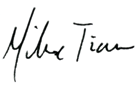 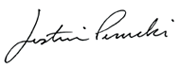 | Mike Tian and Justin Perucki
Editors, Morningstar Opportunistic Investor The Morningstar Guarantee
If you are unhappy with Opportunistic Investor for any reason, cancel within 30 days of your trial start date by calling toll-free 1-866-910-1145, and your credit card will not be charged. After that, you may cancel at any time, and we will refund the remaining months left on your subscription. Your satisfaction is our priority. | |





0 comments:
Post a Comment